
I was writing something recently and wanted to use a sentence along the lines of "The OER world is growing by leaps and bounds." I would have preferred to say it was "growing exponentially" ... but I am unwilling to use that word unless it is at least approximately correct in the technical mathematical sense. So I thought I should look around and find the actual graph which showed "the size of the OER world" over time. Surely this is something widely known which was just slipping my mind at the moment.
I couldn't find that graph.
So I'm trying to make one.
Can you help?
Maybe you want to skip directly to some particular part of this discussion. If so, this might be useful:
I thought I would start on the road to making the desired "size of the OER world over time" graph by visiting a few of the OER repositories that I use the most myself, e.g. when working with colleagues who want an OER for their class textbook.
So that's part of my bias here: I'm looking for things that are essentially textbooks. This is somewhat against my personal inclination: I believe strongly that many of the most pedagogically effective OER do not look much at all like a textbooks. [In fact, if we're not careful, I will end up ranting about the horrible mistake of thinking of OER as a form of textbooks. FWIW, I keep this in my head in a file labeled The Beauty of Ugly OER, where "ugly OER" is a way I talk about things that are not much like beautiful, highly produced textbooks, but can be beautiful for some pedagogical purpose.]
What is to be considered a "textbook" should be taken in the most expansive sense, certainly including any and all formats, as well as things which might be called workbooks, handbooks, and other textbook-adjacent, book-like educational resources. We impose no hard cut-off for a minimum length — although something which is less than 15 or 20 pages when printed seems more like a "handout" than a textbook! — but rather leave it to the authors and data collectors to judge.
OK, this begs the next question: what is an OER?
I'm fairly happy with the definition given by
the Creative Commons
(see the
Creative Commons page What is OER), which
(essentially) requires a work either to be known to be in the public
domain, e.g., if it has the CC Public Domain
Mark [CC PDM] or was released by its
rightsholder with the CC0 Public Domain Dedication
Tool, or was released with one of the CC licenses CC
BY, CC BY-SA,
CC BY-NC, CC BY-NC-SA — but not
the CC licenses CC BY-ND or CC BY-NC-ND.
In essence, I stand by the following diagram of licenses and tools for
OER or non-OER:
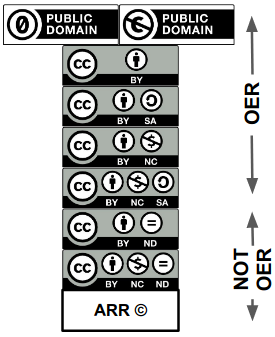
This is not entirely without controversy. Some feel strongly that OER should not use the NC clause. Some feel that also the SA clause is too restrictive. I confess that, personally, I believe OER should [always? whenever possible?] use the SA clause, to keep all of their downstream adaptations in the open world].
Additionally, for artifacts which are entirely or mostly software, Creative Commons licenses are not considered appropriate, and we might have to discuss which free software licenses we consider to be open enough. However, that issue doesn't matter here, since we are already restricting our attention just to textbooks. One could imagine an OER textbook which was entirely in the form of a Jupyter notebook, for which the creator might use an open software license ... but I know of no examples of that type which do not also include a CC license on the textual parts of the work.
Therefore we declare, for this study
Another choice that I feel is appropriate is:
In particular, that brilliant book whose manuscript you've been keeping in the back of a drawer, even if it is completely done and could be used in a class tomorrow (and even if it is really brilliant) doesn't count. If you use it once in a class, or put it on your personal website, or in an obscure, disciplinary repository ... or if it is accepted into one of the major, well-known OER repositories, it will from then on always be considered an existing OER.
This seems to make sense because once a work has been shared publicly, with one of the Creative Commons licenses as in FC2, it can continue to be shared and distributed since CC licenses are irrevocable. It doesn't seem reasonable to discriminate between the well-known, "important" OER repositories and some more bespoke way a work may be shared: works in both kinds of places are out there being useful and with the potential to continue to be useful in the future.
Technically, if you want extreme precision in this concept of "shared in some public form," let's say that what we are going after is the public sharing or performance in the eyes of copyright law, say in situations where copyright law would give a rightsholder power to control public performance, or in the sense that, since v4.0 of the CC licenses, one is allowed to make derivatives of works released under a NoDerivatives license, just not to share those derivatives publicly. In practice, for data collection, I imagine we will always use the simpler subset of this concept defined as: work was shared at least once on a public website.
What the framing choices FC1-FC3 give us is most of a definition of the items of our study, the population. [Well, except for one aspect of the ontology of our population, which we'll talk about in just a moment.] What interests me about this population, and what I think might be an interesting thing for the OER community to know, is:
So, what we want to do is count the population. In fact, we want a count of the population at every moment in the past. Well, it would be silly to start the count before the Creative Commons existed, since then FC2 would have had no meaning. So let's go back, as much as possible, to around the turn of the millennium.
One thing to notice right away is that the graph we are seeking will always be increasing ("trends upwards"), because of FC3.
Here's a odd point: when you are counting things, you have to know when two of them are the same or different. One is tempted to say that pretty much all OER exist in the form of digital files, so it should be easy to compare if two files are identical. (E.g., in Linux, there's a command "diff <filename1> <filename2>" which tells you instantly.)
The problem with this approach is that if someone changes a few or a lot of the bits in a file, it might nevertheless be considered to be "pretty much the same thing" to a human, but not to a computer comparing the files. For example, format shifting such as Word→PDF (or <that format OpenStax uses> → Pressbooks, a transformation which has mattered to faculty on my campus) is not considered, in the eyes of copyright law, to be making an adaptation, but rather to be making a copy: building that version in another format is, under the law, copying even though in technical practice it is done by running a fairly complex program and not by simply duplicating the bits.
In fact, this suggests a solution to our ontological dilemma: copyright law and practice has developed by necessity a system for determining when two works of original authorship (such as textbooks) are the same and when they are different, because the right to make copies, which vests in the copyright holder, is about the right to make other instances of copyrighted works which are the same as the original. Let's just import this concept into our research project, to wit:
Here's an interesting side-note: whether a work is in the public domain can vary between jurisdictions. So also can the judgments about when two works are considered to be the same in the eyes of copyright law. It follows that the graph which would result from a successful prosecution of this research project might vary depending upon whose legal system we are choosing to apply in FC2 and FC4.
The differences depending upon local legal systems seem likely to be quite small, particularly in comparison with the problem of getting high quality and complete data (see discussion below), so I think it makes sense mostly to ignore this jurisdictional issue.
I think we have only one last decision to make as we conceptualize this research project: in the Research Question, we mentioned time — what time (date) will we associate with an individual in the population determined by FC1-FC3?
There are two possibilities which suggest themselves from our Framing Choices: the date a work is released with one of the statuses required by FC2; or the date a work was shared the public forum required by FC3.
It seems to me that going with the date of public sharing is an approach more likely to be difficult to follow accurately. Works don't often appear with a date of publication, whereas they usually have a copyright date on them, and often (at least if they were created with the intention of being OER) they are put under a CC license at that time of copyright. This leads us to our final:
Note that this approach not only seems to be more likely to be possible to follow, but also matches the strategy of FC4 that "copyright law has already thought about this issue and we should just follow its lead."
To summarize:
Clearly, to follow through on this research program, I need to assemble a database of all individuals satisfying FC1-FC3, each decorated with the year they were copyrighted. It should be easy to write code which counts the number of items which have any given copyright year, and then make a graph which accumulates the population size over time by adding the numbers for years up to and including a particular year.
I propose the following (hopefully) practical process:
I can go to OER repositories about which I know, search around on their
sites for a list which has the information I need, and build the
database myself.
Note that this database will probably have thousands, up to maybe a few tens of thousands, of entries. This implies that it is too large to be handled entirely by hand (or, at least, I'm not willing to do so), but it is not so large that code to manipulate it need worry particularly about efficiency: those sizes are not a lot by the standards of the computational power of today's consumer electronics.
A few things to think about:
Which leads me to ask:
Here are ways I'd love collaboration:
If you can help in any of those ways, or in a way I haven't thought of, please contact me by email at jonathan.poritz@gmail.com.
When I was wondering about this in the beginning, as mentioned above, after I failed to find some famous graph that had apparently just slipped my mind, I thought I would ask particular OER friends who run repositories. I was hoping they might have the graphs I wanted, at least for their repositories individually. It turns out that they did not ... at least the ones I first happened to ask.
What follows is a few examples of repositories and of the graphs I was able to make of the sizes of their collections of OER textbooks over time. Note that I have made, as yet, no effort to aggregate these data from different repositories.
Since I've had the pleasure of working with the fabulous folks of the Open Education Network, and since one of the first places I go to look for OER when colleagues ask for help finding open resources for their classes is the OEN's Open Textbook Library [OTL] , they were the first people I asked. But it turns out that they didn't have (at least easily accessible) records of the size of the OTL going into the past.
Here's where I had a cute idea: the front page of the OTL shows the number of books currently in their collection. The Internet Archive's Wayback Machine has many historical snapshots of many pages on the Internet. By looking through the snapshots of that OTL front page, with it's boldly declared "this is how many books we have in our collection right now," I would be able to put together (unfortunately by hand) a file showing the size over time of the OTL.
Unfortunately, the OEN only began posting that number on the OTL front page starting in May of 2019, so far as I was able to tell. Nevertheless, I was able to harvest 193 size values in this way; the data are in this file WBM_OTLsize. The resulting scatterplot is
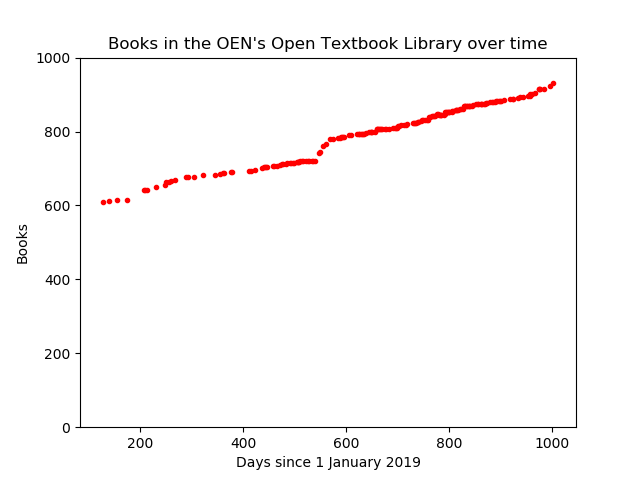
Something to get excited about here: while the data do not go particularly far back in time, there are enough of them so that the trends, in this limited period, should be quite robust. In fact, let's put in a linear regression line, to get:

The fact that there has been a new book every 2.7 days, on average, over the last years (as indicated by the slope of the linear regression line), is pretty impressive!
However, there is a problem with this data source (well, beyond the fact that it only goes back to 2019 and not to the beginning, several years before, of the OTL): before November 2016, the OTL accepted textbooks which had the ND (NoDerivatives) CC license clause. There are therefore a few books being counted in the above graph which we have excluded from our study, meaning that the above curves are a (very slight) exaggeration of what we would get following our research program even just for the OTL textbooks. (The OTL even accepted, early on, a few books with one of the GNU documentation licenses, but that's an even smaller effect, so we're just going to ignore it.)
To deal with that problem, as well as to collect the kind of catalog information described above in the section Request for Collaborators, I also downloaded catalog information for the OTL in the file OTL.csv from the page https://open.umn.edu/opentextbooks/discovery, removed the entries with ND-clause licenses, and made another graph.
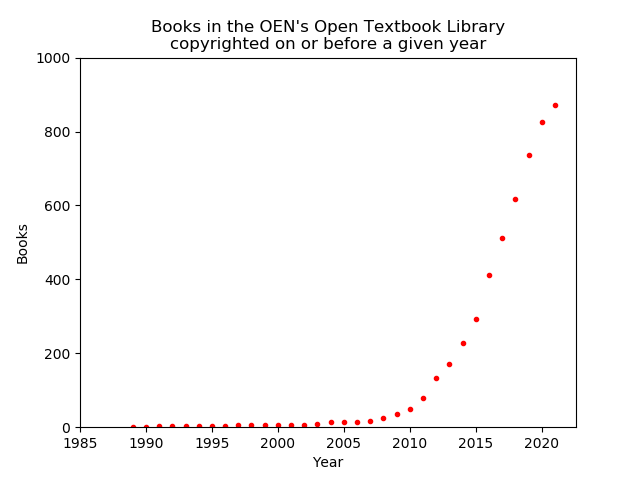
These data clearly are not linear. One is tempted to try an exponential model, which gives this picture:
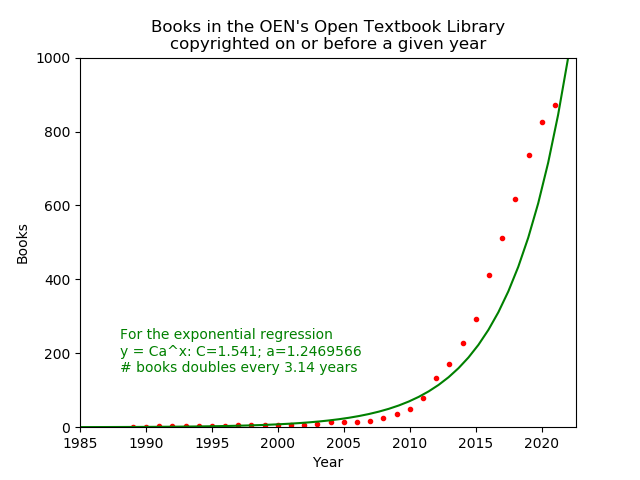
Another approach to fitting a curve would be a piecewise linear (or "broken linear" or "hockey-stick") model, such as this one:
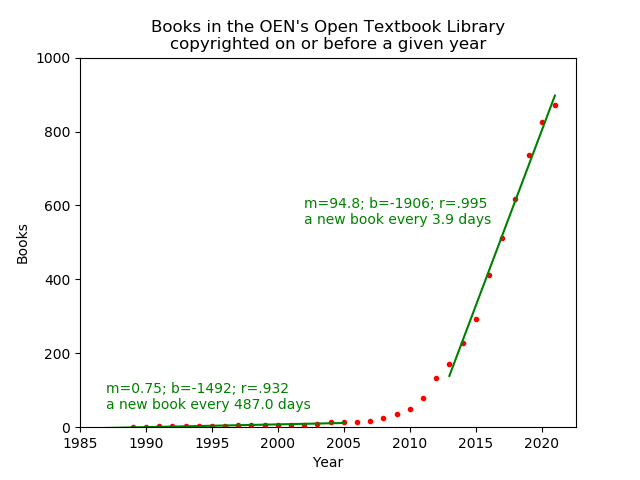
"Hockey-stick" models are always a bit ad-hoc, so probably the best overall description of these copyright year-based data is that they are reasonably well approximated by an exponential curve whose doubling time is a bit more than three years. That's pretty amazing!
The first conference I ever attended on the subject of open textbooks was run by the amazing people from BCcampus. I have continued to learn from them by attending webinars, online workshops, and in-person presentations at open education conferences. I knew, also, that BCcampus runs a wonderful repository: the B.C. Open Textbook Collection.
Amanda Coolidge, Lauri Aesoph, and Josie Gray of BCcampus were able to use the same Wayback Machine approach mentioned above to map out the growth of the B.C. Open Textbook Collection over time. These data result in the graph:
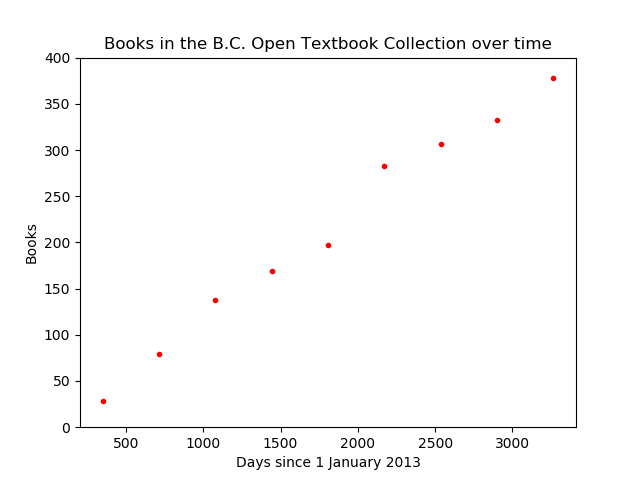
This looks quite linear, so it begs us to make the graph:
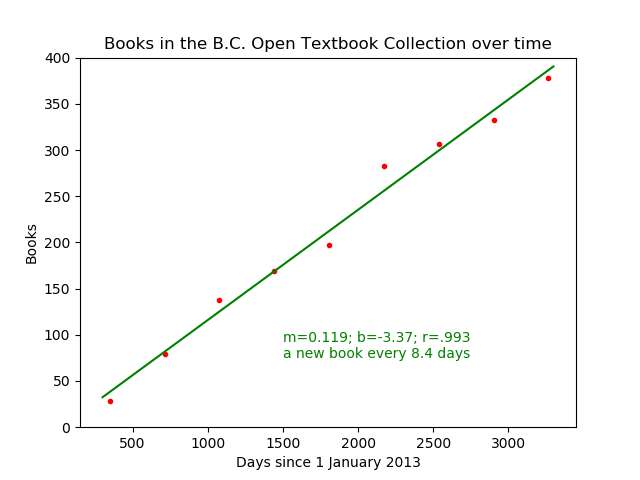
BCcampus does provide MARC records for the B.C. Open Textbook Collection so the approach of using copyright years and aggregating across different repositories suggested above should be possible.
Another place to which I turn for OER to suggest to my colleagues is OER Commons. Their page https://www.oercommons.org/oer shows a count of objects in their collection by type, and one of the types is "Textbooks." We can therefore use the same Wayback Machine approach to make a graph
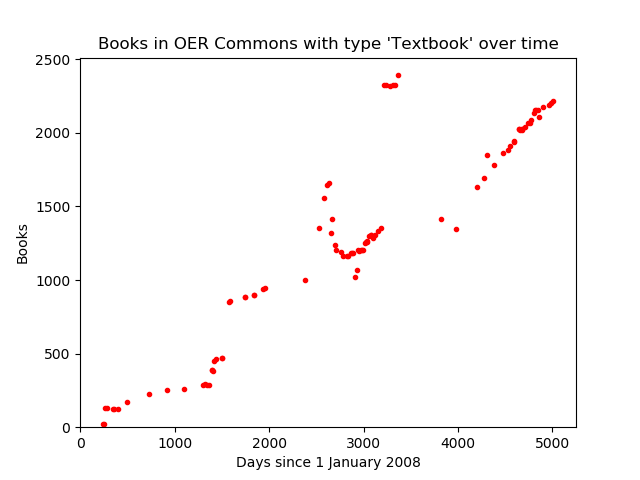
This is much more chaotic: something is going on which is pretty far from the approach we had imagined for our research project. The curve is not even increasing! Presumably this is because objects are being reclassified as having or not having the tag "Textbook," or collections migrated into and out of the entire repository.
Nevertheless, let's just put a big linear regression line on the graph for fun:
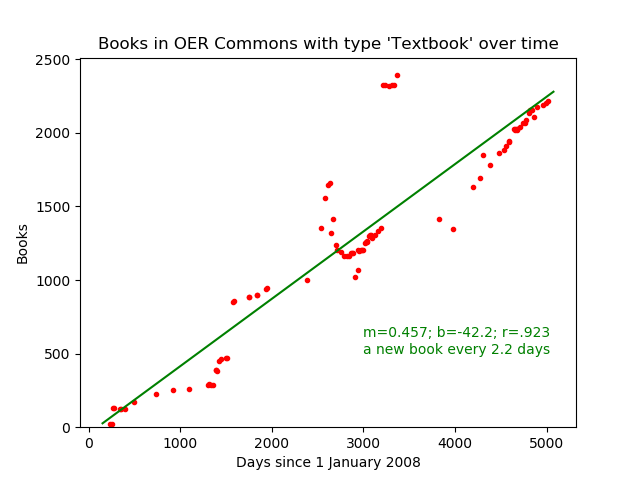
Hopefully a copyright years-based approach to the textbooks in OER Commons would clarify the situation — clearly, I need a collaborator at OER Commons or its parent organization ISKME....
The open community is filled with marvelous, generous people. Several have already helped me with this project:
Thanks so much to all of you!
Here is a list of the repositories which I have been able to process so far (or, at least, I have the data, am in the process of processing it, and see no reason it should not be fine):